Antarctica
Antarctica, the frozen continent at the bottom of the world, enters the story of Project Hail Mary not as a pristine wilderness but as a strategic resource to be sacrificed. In the face of the Astrophage-driven solar dimming that threatens to plunge Earth into a catastrophic ice age within decades, Eva Stratt—the Dutch administrator with absolute authority over the global response—turns to the continent's ancient ice as a weapon against the cold. The decision transforms Antarctica into the site of the largest deliberate environmental manipulation in human history, a desperate gamble to buy the species enough time for the Hail Mary mission to find a solution at Tau Ceti.
The Methane Trap and the Nuclear Solution
Antarctica, climatologist François Leclerc explains, was once a lush jungle. Millions of years of continental drift and natural climate change froze it over, and the decomposition of that ancient plant life trapped vast quantities of greenhouse gases—most critically methane—beneath the ice. Methane is a far more powerful greenhouse gas than carbon dioxide, and Leclerc, a lifelong environmental activist who never imagined he would order such an act, calculates that releasing it is the only way to counteract the rapid cooling. The plan he devises, with Stratt's full backing, is to detonate 241 nuclear weapons buried 50 meters deep along a fissure in the western Antarctic ice shelf, at three-kilometer intervals. The explosions are designed to cleave the shelf, sending enormous chunks of ice into the sea to melt and release their trapped methane into the atmosphere.
The Detonation and Its Immediate Aftermath
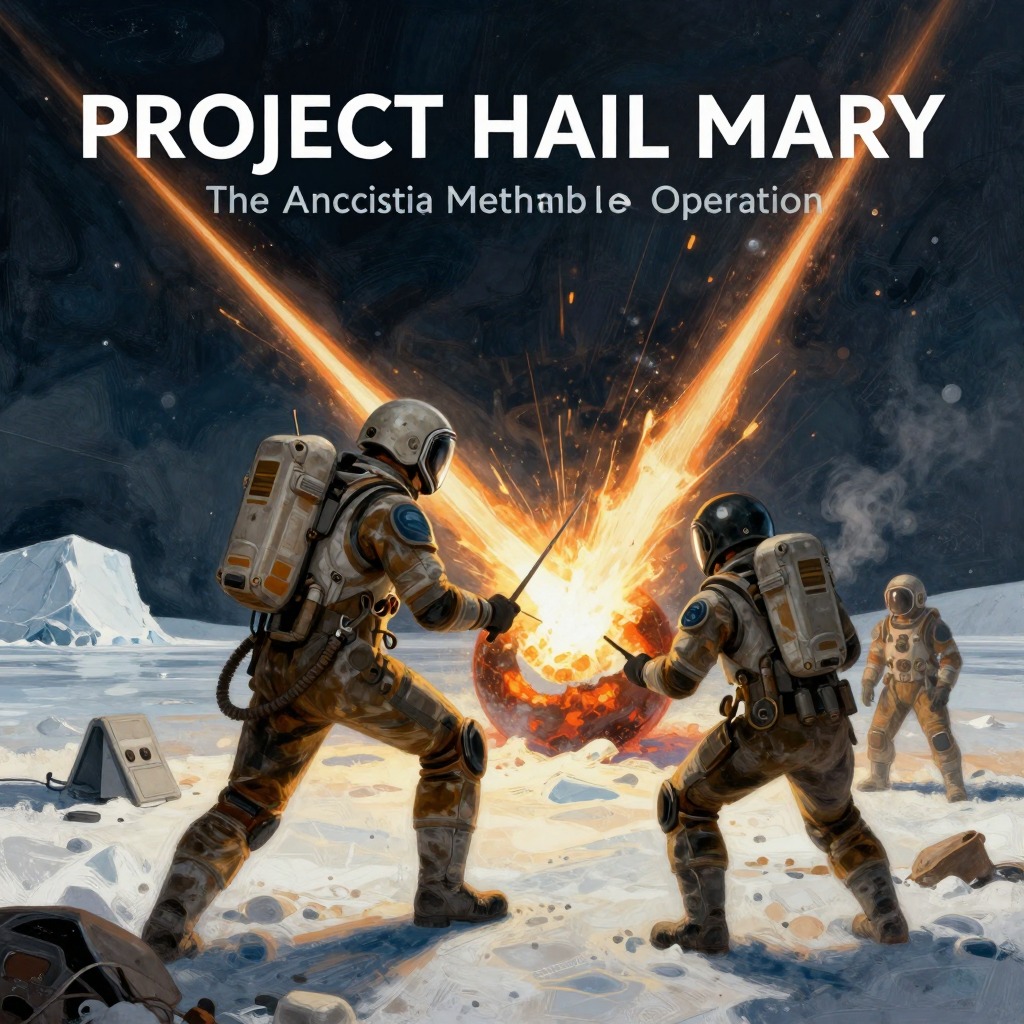
The operation is carried out from the deck of an aircraft carrier anchored off the coast of western Antarctica, the entire continent having been evacuated as a precaution. The naval exclusion zone is the largest in history, and Stratt coordinates the strike with clinical precision, ordering destroyers and submarines to confirm their observation status. Leclerc, standing beside Stratt and Grace, watches the countdown with visible anguish, calling the moment of detonation. The nukes detonate silently, the shockwave arriving ten minutes later as distant thunder. Leclerc, who has spent his career trying to save the environment, buries his face in his hands and cries. Stratt puts a hand on his shoulder, telling him he did what he had to do.
Consequences and a Calculated Risk
The immediate effect is a calculated disruption: the ice shelf cleaves, sea levels rise about a centimeter over the following month, and the ocean temperature drops a degree—a disaster in its own right, but a necessary one. The methane released into the atmosphere acts as a temporary thermal blanket, slowing the rate of global cooling. Leclerc notes that methane breaks down in the atmosphere after about ten years, meaning the intervention is a stopgap, not a permanent solution. Stratt's plan is to repeat the process, knocking more chunks of Antarctica into the sea every few years to moderate methane levels, buying the twenty-seven years she calculates the Hail Mary mission needs. The ecological cost is immense—unpredictable weather, crop failures, and biome annihilation—but the alternative, as Leclerc grimly projects, is the death of half the human population within nineteen years. The sacrifice of Antarctica's ancient ice becomes the price of a fighting chance.